
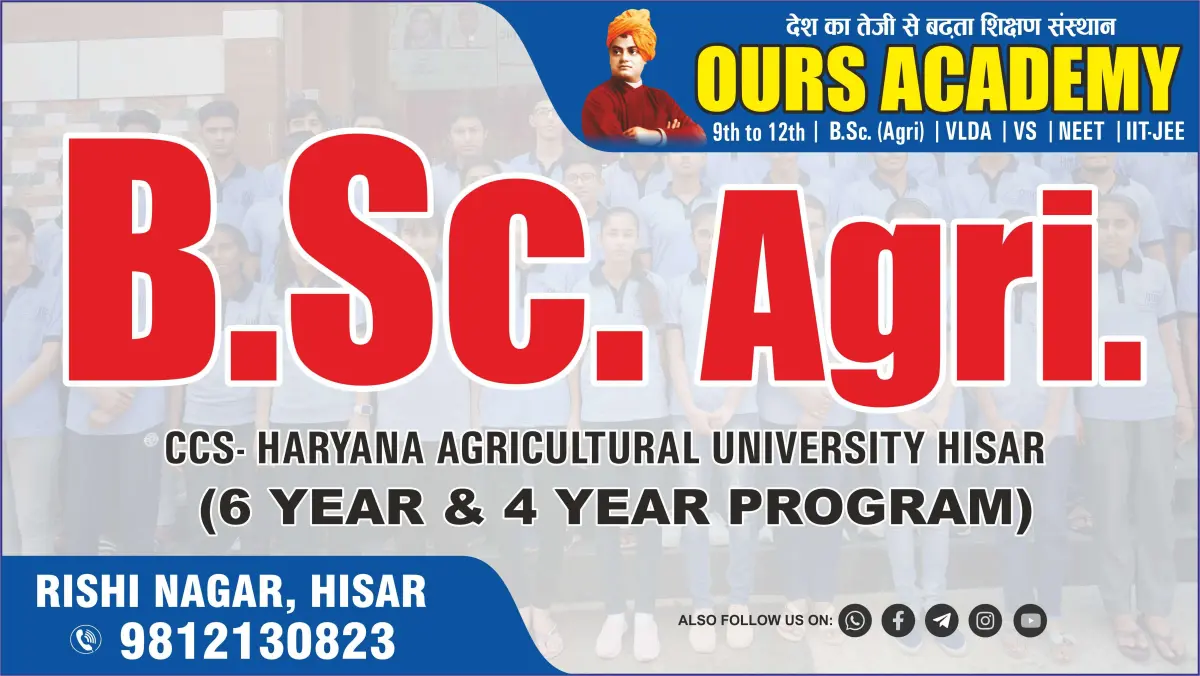
🎓 B.Sc Agriculture
4-Year Undergraduate Degree Program
Course Overview
B.Sc Agriculture is a comprehensive 4-year undergraduate degree program that focuses on the scientific principles and modern applications of agriculture. This course is designed to provide students with in-depth knowledge of agricultural sciences, crop production, soil management, water resource utilization, and sustainable farming techniques.
The program covers multiple specialized streams such as Agronomy, Horticulture, Plant Pathology, Entomology, Soil Science, Agricultural Economics, Food Technology, Fisheries, Forestry, Veterinary Science, and Home Science. It integrates theoretical learning with practical exposure to ensure students gain real-world agricultural expertise.
The primary objective of the course is to equip future professionals with advanced agricultural techniques to improve crop productivity, enhance soil fertility, manage water resources efficiently, and minimize crop losses. With growing global concerns like climate change and food security, agricultural education plays a vital role in sustainable development.
The average course fee for B.Sc Agriculture in India ranges from ₹2 Lakhs to ₹3 Lakhs depending on the institution, while international universities may charge between ₹10 Lakhs to ₹20 Lakhs annually.
Eligibility Criteria
To pursue B.Sc Agriculture, students must fulfill the following requirements:
🎓 Academic Qualification
Completion of 10+2 or equivalent examination (preferably Science stream).
📚 Mandatory Subjects
Physics, Chemistry, and Biology or Mathematics.
For students planning to study abroad, additional requirements may include:
Admission may be merit-based or entrance-exam based, depending on the institution.
B.Sc Agriculture Subjects
The B.Sc Agriculture curriculum includes a wide range of core and applied subjects such as:
These subjects help students build expertise in crop production, pest management, soil science, irrigation systems, agricultural research, and agri-business management.
Admission Process in India
The admission procedure for B.Sc Agriculture varies depending on the university. Generally, it follows one of the two methods:
1️⃣ Merit-Based Admission
Selection is based on 10+2 academic performance.
2️⃣ Entrance Examination-Based Admission
Students must apply and appear for state or university-level entrance exams. Admission is granted based on qualifying scores.
Some of the popular entrance exams include:
Shortlisted candidates may also be required to attend counseling or interviews.
Scope and Opportunities
Agriculture is one of the largest contributors to the global economy and a major employment sector in India. With increasing concerns related to climate change, sustainable farming, and food security, the demand for skilled agricultural professionals continues to rise.
Despite technological advancements in other sectors, agriculture remains a stable and growing industry offering long-term career security and competitive salaries.
🎓 Higher Studies
💼 Career Opportunities
Scope in India
India being an agriculture-driven economy offers vast opportunities in both government and private sectors. Numerous organizations recruit B.Sc Agriculture graduates for research, development, and management roles.
Top Recruiters in India
Prestigious Research Institutions
💰 Salary Prospects
The salary structure in the agricultural sector varies depending on specialization, job profile, and experience level. On average, professionals in this field earn between ₹2 Lakhs to ₹8 Lakhs per annum, with higher growth potential in research, agri-business, and government sectors.
🎓 Why Choose Ours Academy for B.Sc Agriculture Preparation?
At Ours Academy, we understand that B.Sc Agriculture is not just a course — it is the foundation of a promising and impactful career. Our expert guidance and structured preparation help students secure admission in reputed agricultural universities with confidence.
🌟 What Makes Us Different?
Conclusion
B.Sc Agriculture is a dynamic and future-oriented program that combines science, technology, and sustainability. It opens doors to diverse career opportunities in research, government services, agribusiness, and environmental management.
With increasing global demand for sustainable food production and agricultural innovation, this course offers both stability and growth, making it an excellent career choice for students interested in agriculture and rural development.